Amphibians Guide
Dusky Salamander
What Is a Dusky Salamander? The dusky salamander (Desmognathus fuscus) is a small, semi-aquatic amphibian belonging to the lungless salamander family, Plethodontidae. It is one of the most common and widespread …
At a glance
What Is a Dusky Salamander?
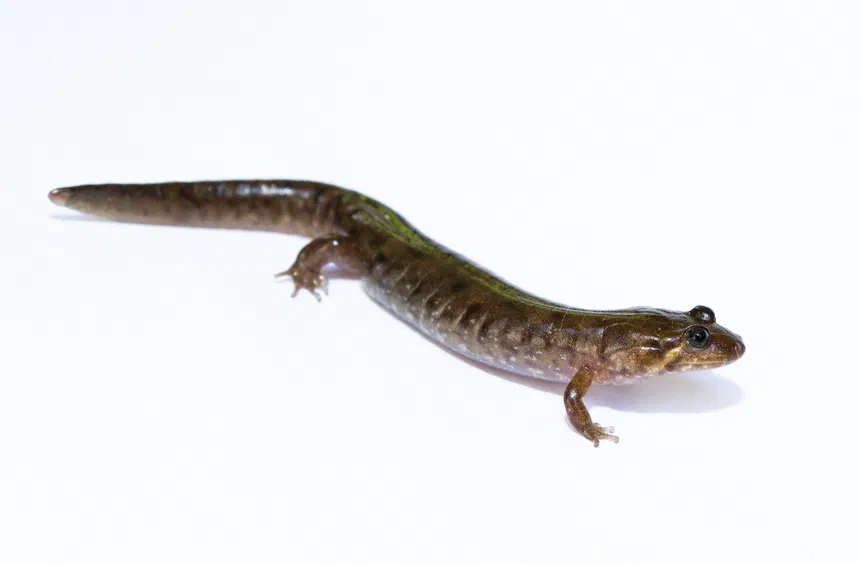
The dusky salamander (Desmognathus fuscus) is a small, semi-aquatic amphibian belonging to the lungless salamander family, Plethodontidae. It is one of the most common and widespread streamside salamanders across eastern North America, where it lives in and around cool, running water. Like other members of its family, it breathes entirely through its skin and the lining of its mouth.
Appearance and Identification
Dusky salamanders are modest in size, typically measuring around 6.5 to 14 centimeters in total length, with a slender build and a laterally compressed, keeled tail. Coloration is variable and often muted, ranging from tan and brown to gray, frequently with darker mottling, blotches, or a wavy-edged dorsal band. The belly is usually pale or lightly speckled. A useful field mark is a pale, diagonal line running from the eye to the angle of the jaw. The hind legs are noticeably stouter than the front legs, an adaptation that helps this species push off and leap when disturbed. Because coloration is so variable and several closely related species overlap in range, positive identification can be difficult without close examination.
Habitat and Range
This species is closely tied to water. It is found along the margins of small brooks, springs, seeps, and rocky streams, usually hiding beneath stones, logs, leaf litter, or in moist crevices near flowing water. It favors cool, well-oxygenated, unpolluted streams in forested settings. The dusky salamander occurs widely across eastern North America, from southeastern Canada southward through the Appalachian region and neighboring lowlands. Because it depends on clean, moving water and moist microhabitats, it is sensitive to stream pollution, sedimentation, and the loss of shaded streamside vegetation.
Diet
The dusky salamander is a carnivore that feeds on a wide variety of small invertebrates. Its diet includes insects and their larvae, spiders, mites, small crustaceans, worms, snails, and other soft-bodied prey it encounters near the water’s edge. It is largely a sit-and-wait predator, ambushing prey that wanders within reach and seizing it with a quick lunge. Foraging usually takes place at night or during damp, humid conditions when the risk of drying out is lowest.
Behavior
Dusky salamanders are secretive and most active after dark, spending daylight hours tucked under cover close to water. They are agile and, when threatened, can flip and jump surprisingly well to escape predators such as snakes, birds, and larger salamanders. Adults may defend small territories around prime cover and foraging sites. Because they lack lungs, all gas exchange happens across moist skin, so these salamanders must stay damp and rarely stray far from a reliable water source.
Life Cycle and Reproduction
Breeding generally occurs in the warmer months. Females lay clusters of eggs in hidden, moist spots close to water, such as beneath rocks, logs, or in wet cavities along stream banks. A distinctive trait of this species is maternal care: the female typically remains coiled around her eggs to guard them and keep them moist until they hatch. The newly hatched larvae are aquatic and have external gills, living in the stream for a period of months before undergoing metamorphosis into the terrestrial juvenile form. Individuals may take a couple of years to reach maturity and can live for several years in the wild.
Conservation Status
The dusky salamander is generally common and widespread, and it is listed as Least Concern on the IUCN Red List. Nonetheless, its dependence on clean, cool, flowing water makes local populations vulnerable to habitat degradation. Stream pollution, sedimentation from erosion, deforestation of streamside buffers, and altered water flow can all reduce suitable habitat. As a sensitive, water-dependent species, it can serve as a useful indicator of the health of small forested streams.
Frequently Asked Questions
Is the dusky salamander poisonous or dangerous to people? No. It is harmless to humans, produces no dangerous venom, and poses no threat. Like all amphibians, it should be handled gently and with clean, wet hands, if at all.
Where would I most likely find one? Look under flat rocks, logs, and leaf litter at the edges of cool, shaded streams, springs, and seeps in eastern North American forests, especially at night or after rain.
Why doesn’t it have lungs? As a member of the lungless salamander family, it exchanges oxygen and carbon dioxide directly through its moist skin and mouth lining, which is why it must remain damp and stay near water.