Amphibians Guide
Darwin's Frog
What Is a Darwin’s Frog? Darwin’s frog (Rhinoderma darwinii) is a small, secretive amphibian native to the temperate forests of southern South America. It is best known for a remarkable parental strategy in which the …
At a glance
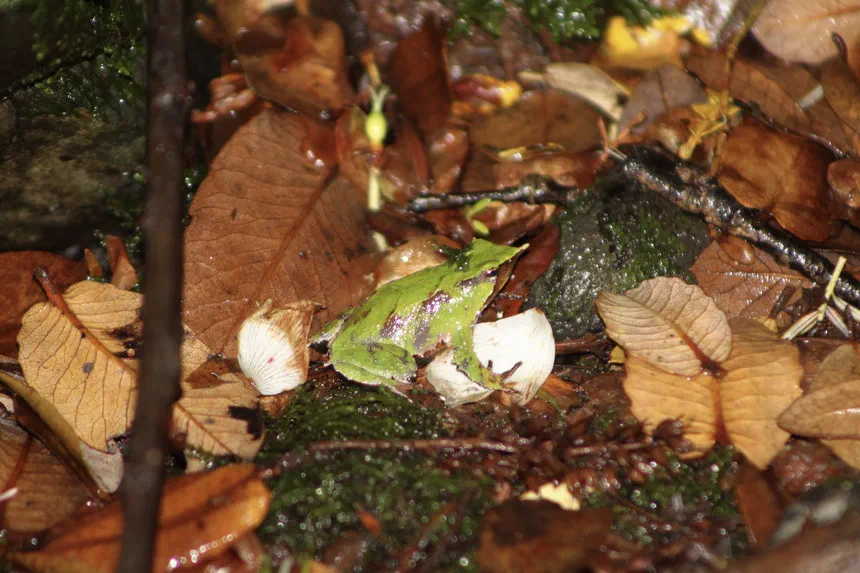
Image: Jalmonacida — CC BY-SA 4.0 · source
What Is a Darwin’s Frog?
Darwin’s frog (Rhinoderma darwinii) is a small, secretive amphibian native to the temperate forests of southern South America. It is best known for a remarkable parental strategy in which the male carries developing young inside his vocal sac. The species was first noted by Charles Darwin during the voyage of the Beagle, which is how it earned its name.
Appearance and Identification
This is a tiny frog, typically measuring only 2.5 to 3.5 centimeters (about 1 to 1.4 inches) from snout to vent and weighing just a few grams. Its most distinctive feature is a pointed, fleshy projection on the tip of the snout, giving the head a leaf-like silhouette. Coloration is highly variable, ranging from bright green to reddish or grayish brown, often with darker mottling, while the underside is marked with contrasting black and white patches. This cryptic patterning makes the frog resemble a dead leaf on the forest floor, an effective form of camouflage.
Habitat and Range
Darwin’s frog inhabits the cool, moist native forests of southern Chile and parts of adjacent Argentina. It favors the shaded floors of temperate rainforests, particularly near slow-moving streams, bogs, and mossy ground where humidity stays high. The species depends on relatively undisturbed forest with abundant leaf litter, and it is closely tied to the Nothofagus (southern beech) woodlands characteristic of the region.
Diet
As a carnivore, Darwin’s frog feeds on small invertebrates found among the leaf litter and low vegetation. Its diet includes insects such as beetles, flies, and ants, along with spiders, snails, and other small arthropods. The frog hunts by ambush and short lunges, relying on its camouflage to approach prey and avoid predators alike.
Behavior
Darwin’s frog is primarily active during the day but stays well hidden, moving quietly through the leaf litter. When threatened, it may freeze and rely on its leaf-like appearance, or flip onto its back to display the boldly patterned belly before lying still, mimicking a dead leaf. It is generally solitary outside the breeding season. Males become more vocal during breeding, producing soft calls to attract females.
Life Cycle and Reproduction
The reproduction of Darwin’s frog is among the most unusual in the animal kingdom. After a female lays a small clutch of eggs on moist ground, one or more males guard them until the embryos begin to move. At that point a male takes the eggs into his mouth and slips them into his vocal sac, where the tadpoles complete their development in safety. The young remain inside the sac, nourished in part by secretions, until they emerge weeks later as fully formed froglets. This mode of parental care, sometimes called mouth-brooding, greatly increases the survival of the offspring.
Conservation Status
Darwin’s frog is classified as Endangered by the IUCN, and its populations have declined across much of its historic range. The main threats include the clearing and fragmentation of native forest, conversion of land to plantations and agriculture, and the spread of the amphibian chytrid fungus, which has devastated frog populations worldwide. Climate change and habitat drying add further pressure. Conservation efforts include habitat protection, captive breeding programs, and disease monitoring, but the species remains vulnerable to ongoing forest loss.
Frequently Asked Questions
Why is it called Darwin’s frog? The frog is named after Charles Darwin, who encountered it in southern Chile during his travels aboard HMS Beagle in the 1830s.
How does the male carry the tadpoles? The male scoops the developing eggs into his vocal sac, where the tadpoles grow until they emerge as tiny froglets, protected the entire time.
Is Darwin’s frog dangerous to humans? No. It is a harmless, tiny insect-eater that poses no threat to people and is itself highly sensitive to environmental disturbance.