Amphibians Guide
Common Frog
What Is a Common Frog? The common frog (Rana temporaria), also called the European common frog or grass frog, is one of the most widespread amphibians across Europe. It is a familiar sight in gardens, ponds, and damp …
At a glance
What Is a Common Frog?
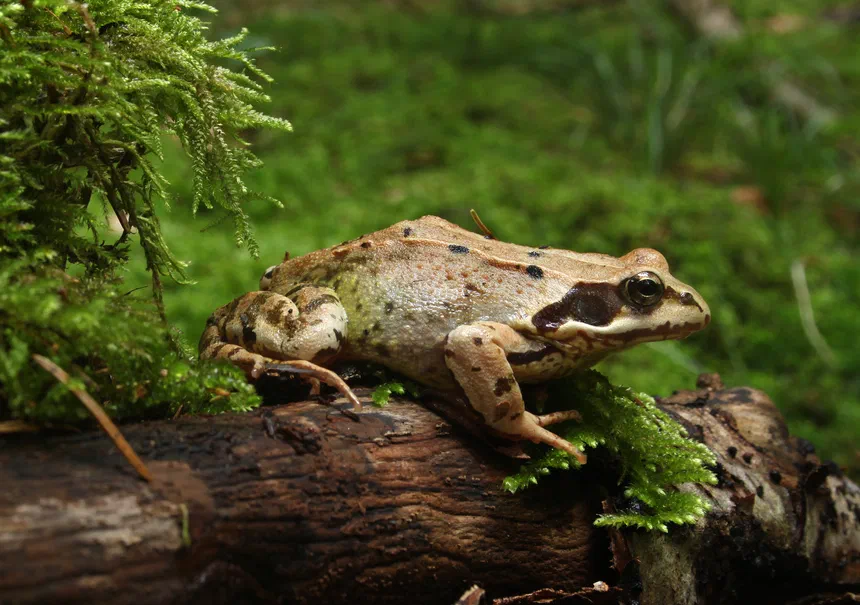
The common frog (Rana temporaria), also called the European common frog or grass frog, is one of the most widespread amphibians across Europe. It is a familiar sight in gardens, ponds, and damp countryside, where its spring breeding gatherings and jelly-like spawn are well known. As a hardy, adaptable species, it thrives in cool, moist environments from lowlands to mountain slopes.
Appearance and Identification
The common frog has a rounded body, a blunt snout, and smooth, moist skin that ranges in color from brown and olive to gray, yellow, or reddish. Individuals are highly variable and can even change tone somewhat to match their surroundings. Most bear irregular dark blotches on the back and bands across the hind legs, and a distinctive dark patch runs from behind each eye over the eardrum. The belly is paler, often whitish or yellowish, and may be mottled. Its long, muscular hind legs are built for hopping and swimming, while partially webbed hind feet aid movement through water. Adults typically measure about 6 to 9 centimeters from snout to vent, with females generally larger than males. During the breeding season, males develop dark nuptial pads on their forelimbs to grip females.
Habitat and Range
The common frog occupies a broad range across most of Europe, extending eastward into parts of western Asia and reaching well into Scandinavia and other cool northern regions. It is one of the few amphibians found north of the Arctic Circle. Outside the breeding season, it spends much of its time on land in damp, sheltered places such as woodland, meadows, hedgerows, marshes, and gardens. For breeding it relies on still or slow-moving fresh water, favoring shallow ponds, ditches, and pools. Its tolerance for cool climates and human-altered landscapes has helped it remain common across much of its range.
Diet
Adult common frogs are carnivores that feed on a wide variety of small invertebrates. Insects, spiders, slugs, snails, worms, and other soft-bodied creatures make up the bulk of their diet. They hunt largely by sight, sitting still until prey moves within range and then flicking out a sticky tongue to capture it. Tadpoles, by contrast, begin life feeding mostly on algae and plant matter before becoming increasingly carnivorous as they grow, scavenging and taking small aquatic animals as they approach metamorphosis.
Behavior
The common frog is most active at dusk and after rain, when damp conditions let it move about without drying out. It is generally solitary outside of the breeding season and relies on camouflage and quick, powerful leaps to escape predators such as birds, snakes, and mammals. In colder parts of its range it hibernates through winter, sheltering under logs, in mud, in compost heaps, or at the bottom of ponds, where it can absorb oxygen through its skin. When warmer weather returns, frogs emerge and often travel back to the ponds where they were born to breed.
Life Cycle and Reproduction
Breeding takes place in early spring, sometimes while ponds are still partly frozen. Males gather at the water and produce a soft, purring croak to attract females. A male grips a female in a hold called amplexus and fertilizes her eggs externally as she releases them. Each female can lay a large clump of eggs, and the familiar masses of frogspawn often merge into rafts at the water’s surface. The eggs hatch into tadpoles within a few weeks, and over the following two to three months the tadpoles gradually develop legs, absorb their tails, and transform into tiny froglets that leave the water. Young frogs reach breeding age in about two to three years, and adults may live roughly five to eight years in the wild.
Conservation Status
The common frog is listed as Least Concern by the IUCN, reflecting its wide distribution and generally stable populations. Even so, local declines have been noted in some areas due to habitat loss, pollution, the draining of ponds, and disease, including ranavirus and the fungal disease chytridiomycosis. Because frogs breathe partly through their permeable skin, they are sensitive to water quality, and garden ponds play a valuable role in supporting healthy populations.
Frequently Asked Questions
Are common frogs poisonous? Common frogs are not dangerous to people. Their skin can secrete mild substances that taste unpleasant to some predators, but they pose no real threat to humans.
How can you tell a frog from a toad? Common frogs have smoother, moister skin and longer legs for leaping, while toads tend to have drier, wartier skin and shorter legs and often walk or make short hops.
Where do common frogs go in winter? In cold regions they hibernate, sheltering under logs, in compost heaps, or at the bottom of ponds, where they remain dormant until spring.