Amphibians Guide
Chinese Giant Salamander
What Is a Chinese Giant Salamander? The Chinese giant salamander (Andrias davidianus) is one of the largest living amphibians on Earth. A fully aquatic member of the family Cryptobranchidae, it survives in cool, clear …
At a glance
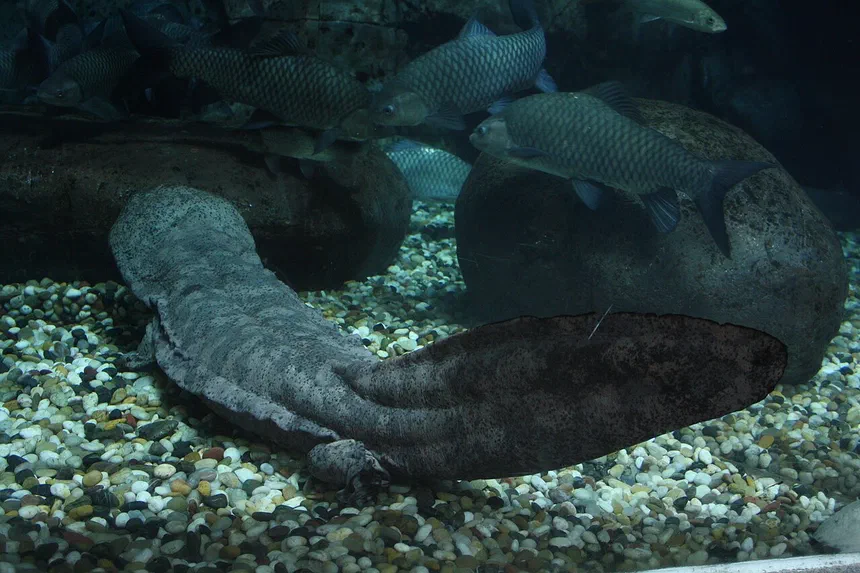
Image: J. Patrick Fischer — CC BY-SA 3.0 · source
What Is a Chinese Giant Salamander?
The Chinese giant salamander (Andrias davidianus) is one of the largest living amphibians on Earth. A fully aquatic member of the family Cryptobranchidae, it survives in cool, clear mountain waterways and is regarded as a “living fossil” whose lineage stretches back many millions of years.
Appearance and Identification
This is a heavy-bodied, flattened salamander with loose, wrinkled skin that hangs in folds along its sides. The coloration is generally mottled dark brown, gray, and black, providing camouflage against rocky stream beds, though individuals can vary toward reddish or lighter tones. The head is broad and rounded with a wide mouth and tiny, lidless eyes set far apart. Most adults reach around 3.6 feet (1.1 meters), and exceptionally large individuals have been reported at over 5 feet (1.5 meters), making this species a candidate for the title of world’s largest amphibian.
Habitat and Range
The Chinese giant salamander historically occurred across a wide swath of central, southwestern, and southern China, within the drainage basins of major river systems such as the Yangtze, Yellow, and Pearl rivers. It favors cool, well-oxygenated, fast-flowing streams and rivers at moderate elevations, typically in forested hills and mountains. Rocky crevices, undercut banks, and submerged cavities serve as shelter and nesting sites. Wild populations are now severely fragmented and rare, and much of what remains in some areas involves farmed or released stock.
Diet
An opportunistic carnivore, the Chinese giant salamander preys on whatever it can catch in its aquatic world, including fish, freshwater crabs and other crustaceans, aquatic insects, worms, frogs, and smaller salamanders. Because its eyesight is poor, it relies heavily on sensory nodes along its head and body to detect vibrations and water movement from nearby prey. Feeding is largely a sit-and-wait ambush: the salamander lunges and uses powerful suction to draw prey into its wide mouth.
Behavior
This species is primarily nocturnal and secretive, spending daylight hours tucked into rock crevices or burrows. It breathes mostly through its skin, absorbing oxygen directly from the water, which is why cold, highly oxygenated streams are essential to its survival. Generally slow-moving and solitary, it can nonetheless be territorial, and individuals may produce vocal sounds sometimes likened to a child’s cry, a trait reflected in one of its Chinese common names.
Life Cycle and Reproduction
Breeding takes place in late summer to autumn. Females deposit long strings containing hundreds of eggs inside underwater den cavities, where a male fertilizes them externally. The male then guards the clutch, guarding the developing eggs against predators and fanning them to maintain oxygen flow until they hatch. Larvae emerge with external gills and gradually mature over several years. Chinese giant salamanders are slow-growing and long-lived, with lifespans commonly reaching 50 to 60 years or more, and captive individuals reportedly living even longer.
Conservation Status
The Chinese giant salamander is listed as Critically Endangered by the IUCN, and wild numbers have declined dramatically. The primary threats are overharvesting for the luxury food trade, habitat loss and degradation from dam construction and pollution, and disruption caused by large-scale commercial farming. Recent genetic studies suggest the animal long treated as a single species may actually represent several distinct species, complicating conservation because farmed animals released into the wild can blur these lineages. Protected areas, captive-breeding programs, and stricter trade controls are central to ongoing recovery efforts.
Frequently Asked Questions
How big can a Chinese giant salamander get? Most adults measure around 3.6 feet (1.1 meters), but exceptional individuals have been recorded at over 5 feet (1.5 meters), placing the species among the largest amphibians alive today.
Is the Chinese giant salamander dangerous to people? No. It is not aggressive toward humans and poses no real threat, though a large individual can deliver a strong bite if handled or provoked.
Why is this salamander endangered? Decades of overharvesting for food, combined with habitat destruction, pollution, and the impacts of intensive farming, have pushed wild populations to critically low levels.