Amphibians Guide
Cane Toad
What Is a Cane Toad? The cane toad (Rhinella marina) is a large, heavy-bodied terrestrial toad native to the Americas. It is one of the world’s most familiar amphibians, both for its size and for its notorious history as …
At a glance
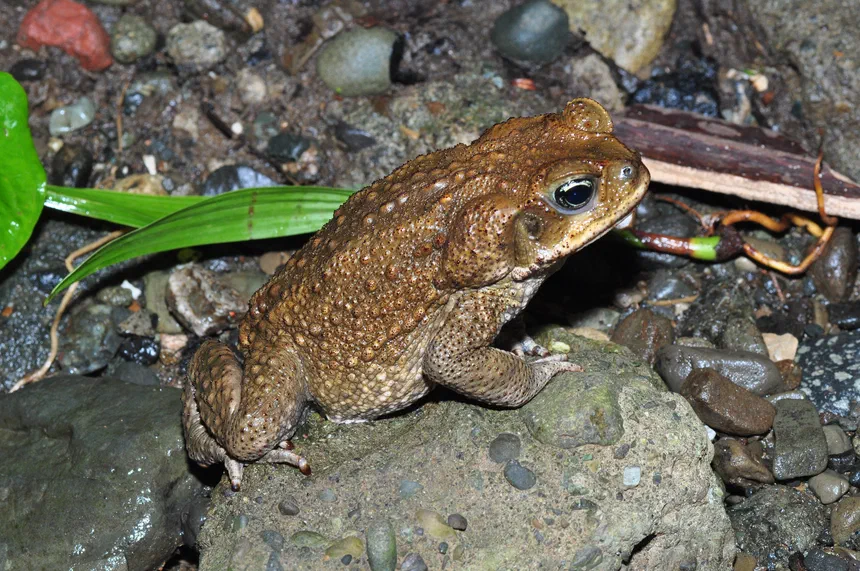
Image: Pavel Kirillov from St.Petersburg, Russia — CC BY-SA 2.0 · source
What Is a Cane Toad?
The cane toad (Rhinella marina) is a large, heavy-bodied terrestrial toad native to the Americas. It is one of the world’s most familiar amphibians, both for its size and for its notorious history as an introduced species that has become invasive across parts of the world. Also known as the giant toad or marine toad, it is prized in its native range as a natural insect predator but reviled elsewhere as an ecological pest.
Appearance and Identification
The cane toad is among the largest toads on Earth. Adults commonly measure 4 to 6 inches (10 to 15 cm) in body length, though exceptionally large individuals can exceed 9 inches. Females tend to grow larger than males. The skin is dry, warty, and colored in shades of olive, gray, yellowish-brown, or reddish-brown, often with darker mottling. The belly is paler and frequently speckled.
The most distinctive feature is the pair of large parotoid glands located behind the eyes, which slope down over the shoulders. These glands secrete a milky toxin called bufotoxin. The toad also has prominent bony ridges above the eyes and short, sturdy limbs suited to hopping and walking rather than long leaps.
Habitat and Range
Native to a broad region stretching from the southern United States through Mexico, Central America, and much of tropical South America, the cane toad is remarkably adaptable. It thrives in grasslands, open woodlands, forest edges, agricultural fields, gardens, and suburban areas. Although an amphibian, the adult is fairly tolerant of dry conditions and does not depend on standing water except for breeding.
Beginning in the 20th century, the species was deliberately introduced to many regions, including Australia, the Caribbean, Hawaii, and various Pacific islands, largely in a failed attempt to control agricultural pests. In Australia especially, it has spread across vast areas and is considered a serious invasive threat.
Diet
The cane toad is an opportunistic omnivore with an enormous appetite. It eats a wide variety of insects, spiders, snails, worms, and other invertebrates, along with small vertebrates such as frogs, lizards, and rodents when it can catch them. Unusually for a toad, it will also consume plant matter, pet food, and household scraps. This dietary flexibility is one reason it establishes so successfully in new environments.
Behavior
Cane toads are mostly nocturnal, sheltering in cool, damp spots during the heat of the day and becoming active at dusk. They are slow-moving and rely on their toxic defenses rather than speed to survive. When threatened, the parotoid glands can release a poison potent enough to sicken or kill predators that bite or mouth the toad, including dogs and native wildlife unfamiliar with it.
They are generally solitary outside of the breeding season and are often drawn to artificial lights, where flying insects gather. This habit brings them into frequent contact with human settlements.
Life Cycle and Reproduction
Reproduction is tied to warm, wet conditions. Females are highly prolific, laying long, gelatinous strings containing thousands of eggs, sometimes 8,000 to 30,000 in a single clutch, in still or slow-moving water. The eggs and resulting tadpoles are themselves toxic, which discourages many would-be predators.
Tadpoles hatch within a few days and develop over several weeks before metamorphosing into tiny toadlets. Growth is rapid, and individuals may reach breeding maturity within a year or so under favorable conditions. In the wild, cane toads typically live about 5 to 10 years, though captive animals have survived considerably longer.
Conservation Status
The cane toad is listed as Least Concern by the IUCN. Far from being threatened, its populations are stable or expanding, and in many introduced regions it is regarded as an invasive pest rather than a species in need of protection. Management efforts in places like Australia focus on limiting its spread and reducing its impact on native wildlife.
Frequently Asked Questions
Are cane toads poisonous? Yes. Their parotoid glands secrete bufotoxin, which can be dangerous or fatal to pets and predators that bite or swallow them. The eggs and tadpoles are also toxic.
Why were cane toads introduced to Australia? They were released in the 1930s to control beetles that damaged sugarcane crops. The plan failed, and the toads instead became a widespread invasive species.
How big can a cane toad get? Most adults are 4 to 6 inches long, but some exceptionally large individuals exceed 9 inches and weigh more than 2 pounds.