Amphibians Guide
Blue Poison Dart Frog
What Is a Blue Poison Dart Frog? The blue poison dart frog is a small, brilliantly colored amphibian native to a few isolated forest patches in southern Suriname. It is widely recognized as Dendrobates tinctorius …
At a glance
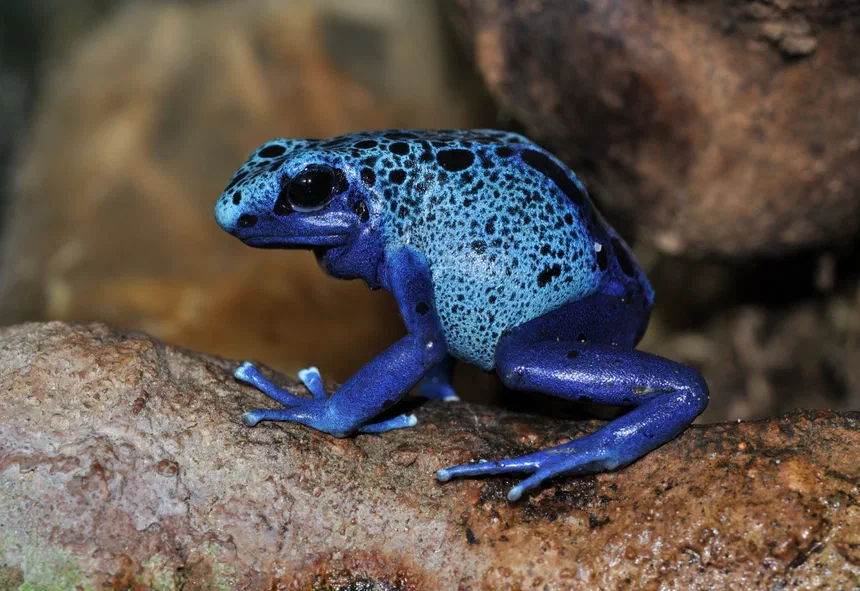
Image: Quartl — CC BY-SA 3.0 · source
What Is a Blue Poison Dart Frog?
The blue poison dart frog is a small, brilliantly colored amphibian native to a few isolated forest patches in southern Suriname. It is widely recognized as Dendrobates tinctorius azureus, a striking blue form of the dyeing poison frog. Its intense coloring is a warning to predators that its skin carries toxic compounds.
Appearance and Identification
This frog is famous for its saturated sky-blue to deep cobalt body, usually darker along the limbs and paler across the back. Scattered black spots mark the head and shoulders, and the pattern is unique to each individual, much like a fingerprint. Adults typically measure about 1.2 to 1.8 inches (3 to 4.5 centimeters) and weigh only a few grams. Females tend to be slightly larger and rounder than males, while males often have broader toe pads used during climbing and courtship.
Habitat and Range
The blue poison dart frog occupies a naturally limited range in the Sipaliwini savanna region of southern Suriname, near the border with Brazil. It lives in humid pockets of tropical rainforest that persist as “islands” surrounded by open savanna. Within these forests it favors the moist leaf litter, mossy rocks, and shaded ground close to small streams and seepages, where humidity stays high and temperatures remain relatively stable year-round.
Diet
Like other poison frogs, it is an active daytime hunter of tiny invertebrates. Its diet centers on ants, termites, mites, springtails, and other small insects gathered from the forest floor. Scientists believe that alkaloid compounds obtained from these prey items, especially certain ants and mites, are the source of the toxins stored in the frog’s skin. In captivity, where such prey is absent, these frogs generally lose their toxicity over time.
Behavior
The blue poison dart frog is diurnal and often bold in its movements, relying on bright coloration rather than concealment for protection. This warning coloration, called aposematism, signals to would-be predators that the frog is distasteful and toxic. Males are territorial and use soft, quiet calls to advertise their presence and attract mates. Individuals may defend small patches of ground and will confront rivals that intrude.
Life Cycle and Reproduction
Breeding is tied to humid conditions, and courtship involves calling and following behavior between a male and female. The female lays a small clutch of eggs, typically only a handful, in a moist, sheltered spot on the forest floor. Males often guard and keep the eggs damp. After the eggs hatch, an adult, usually the male, carries the tadpoles one at a time on its back to small water pools, such as those collected in plant hollows or leaf axils. The tadpoles develop in these tiny pools over several weeks before completing metamorphosis into froglets.
Conservation Status
As a regional color form of the widespread dyeing poison frog, the blue poison dart frog is not always assessed separately, and its parent species is generally listed as Least Concern by the IUCN. Even so, its wild population is confined to a very small area, which makes it vulnerable to habitat disturbance and over-collection for the pet trade. It breeds readily in captivity, and responsibly bred animals help reduce pressure on wild populations.
Frequently Asked Questions
Is the blue poison dart frog dangerous to touch? Wild individuals carry toxins in their skin that can cause irritation, so they should not be handled. Captive-bred frogs raised on a controlled diet typically lack these toxins.
Where does its blue color come from? The color is produced by pigment cells and light-scattering structures in the skin, not by diet. It serves as a warning signal rather than camouflage.
How big do they get? Adults are small, usually reaching only about 1.2 to 1.8 inches (3 to 4.5 centimeters) in length.
References
The conservation status and key facts in this profile are supported by these sources:
- Animal Diversity Web — Blue poison dart frog (Dendrobates azureus / Dendrobates tinctorius) (accessed 2026-07-29)
- GBIF — Dendrobates azureus (accessed 2026-07-29)
Found an error, source problem, or image concern? Report this page.