Amphibians Guide
American Bullfrog
What Is a American Bullfrog? The American bullfrog (Lithobates catesbeianus) is the largest true frog native to North America and one of the most familiar amphibians on the continent. Named for the deep, resonant call of …
At a glance
What Is a American Bullfrog?
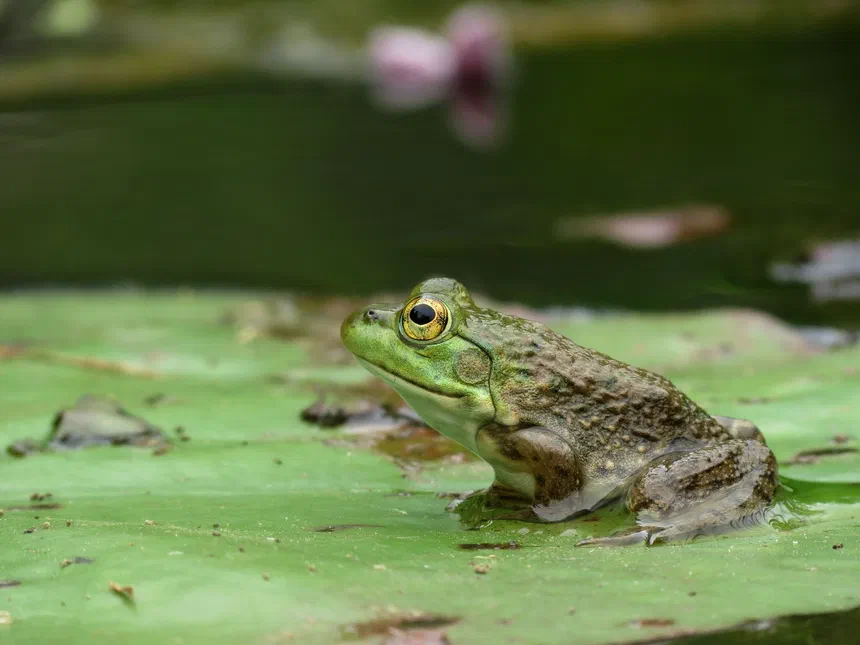
The American bullfrog (Lithobates catesbeianus) is the largest true frog native to North America and one of the most familiar amphibians on the continent. Named for the deep, resonant call of breeding males, it is a heavy-bodied, aquatic frog closely tied to permanent bodies of water. Widely introduced beyond its native range, it has also become a notorious invasive species in many parts of the world.
Appearance and Identification
Bullfrogs are large, robust frogs, with adults commonly reaching three and a half to six inches from snout to vent and occasionally more. Their coloring ranges from bright green to olive or brownish, often with darker mottling on the back and legs, while the underside is cream to pale yellow. A key identifying feature is the large, circular eardrum, or tympanum, located just behind the eye; in males it is noticeably larger than the eye, whereas in females it is roughly the same size. Unlike many related frogs, bullfrogs lack prominent ridges running down the back, and their hind feet are strongly webbed for swimming.
Habitat and Range
The American bullfrog favors warm, still or slow-moving fresh water, including ponds, lakes, reservoirs, marshes, and sluggish streams. It prefers waters with plenty of emergent and floating vegetation that provide cover and hunting perches along the shoreline. The species is native to much of eastern and central North America, from southern Canada through the eastern United States to northeastern Mexico. Through deliberate release and the frog-farming trade, it has been introduced to the western United States and to countries across Europe, Asia, and South America, where it often thrives.
Diet
Bullfrogs are voracious, opportunistic carnivores that will attempt to eat almost any animal small enough to swallow. Their diet includes insects, spiders, worms, and other invertebrates, along with crayfish, fish, and smaller frogs. Larger individuals readily take small snakes, rodents, and even young birds and turtles. They hunt by sitting motionless and ambushing prey, lunging with a wide gape and using their sticky tongue and forelimbs to seize the catch. This broad, aggressive appetite is a major reason introduced bullfrogs can disrupt native wildlife.
Behavior
Adult bullfrogs are largely solitary and can be strongly territorial, especially breeding males that defend stretches of shoreline and call to advertise their claim. The familiar low, booming “jug-o-rum” call carries over considerable distances on warm nights. Bullfrogs are most active in warm weather and become dormant during cold months, overwintering in mud or at the bottom of their pond. When threatened, they typically dive into the water and hide among vegetation or sediment, and they can leap powerfully to escape danger.
Life Cycle and Reproduction
Breeding occurs in the warm months, when males gather at the water’s edge and call to attract females. A single female can lay an enormous clutch—often many thousands of eggs—in a floating film at the water’s surface. The eggs hatch into tadpoles that are themselves large and may take a long time to develop; in cooler climates the tadpole stage can last one to two years or more before metamorphosis. After transforming into froglets, individuals reach sexual maturity over the following years and may live around seven to ten years in the wild, sometimes longer.
Conservation Status
Within its native range the American bullfrog is common and widespread, and the IUCN lists it as Least Concern. Rather than being threatened, the greater conservation concern involves the species itself: where introduced, bullfrogs prey heavily on native amphibians, fish, and invertebrates and compete with local wildlife. They can also carry and spread the amphibian chytrid fungus, contributing to declines in more vulnerable species. As a result, many regions treat established bullfrog populations as an invasive pest and undertake control efforts.
Frequently Asked Questions
Why are American bullfrogs a problem outside their native range? As large, aggressive predators with huge appetites, introduced bullfrogs eat and outcompete native species and can spread disease, making them a damaging invasive species in many areas.
How can you tell a male bullfrog from a female? The easiest clue is the tympanum, the round eardrum behind the eye: it is clearly larger than the eye in males and about the same size as the eye in females. Breeding males also often have a yellowish throat.
What does a bullfrog’s call sound like? Males produce a deep, resonant call often described as “jug-o-rum,” which carries far across the water and is a common sound near ponds on warm summer nights.
References
The conservation status and key facts in this profile are supported by these sources:
- Animal Diversity Web — Lithobates catesbeianus (American Bullfrog) (accessed 2026-07-29)
- GBIF — Lithobates catesbeianus (Shaw, 1802) (accessed 2026-07-29)
Found an error, source problem, or image concern? Report this page.