Amphibians Guide
African Clawed Frog
What Is a African Clawed Frog? The African clawed frog (Xenopus laevis) is a fully aquatic frog native to ponds and wetlands across sub-Saharan Africa. It takes its name from the short, dark claws on its hind feet, which …
At a glance
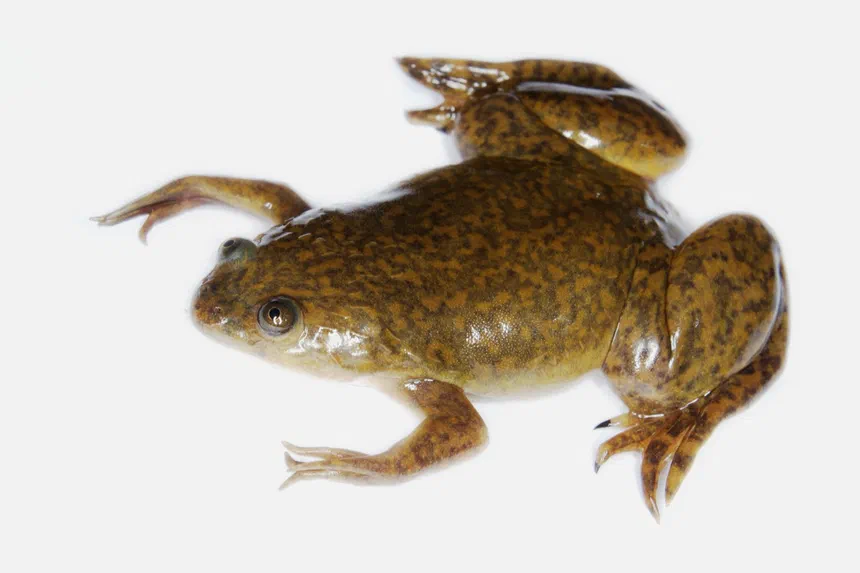
What Is a African Clawed Frog?
The African clawed frog (Xenopus laevis) is a fully aquatic frog native to ponds and wetlands across sub-Saharan Africa. It takes its name from the short, dark claws on its hind feet, which it uses to grip and tear apart food. Hardy and highly adaptable, it has become one of the most widely used laboratory animals in the world and an invasive species on several continents.
Appearance and Identification
The African clawed frog has a flattened, egg-shaped body built for life in water, with a small, wedge-shaped head and no external eardrum. Its powerful hind legs are fully webbed and end in three claw-tipped toes, while the front legs are slender with unwebbed fingers used to funnel food toward the mouth. Adults usually measure 2 to 5 inches from snout to vent, with females noticeably larger and heavier than males. The upper body ranges from olive-green to grayish-brown, often mottled to blend with muddy bottoms, while the underside is pale cream or yellowish. The eyes sit high on top of the head and are small and lidless, and a distinctive line of stitch-like sensory organs runs along each flank, forming the lateral line system that detects movement in the water.
Habitat and Range
Naturally, this frog lives across much of sub-Saharan Africa, from South Africa northward through countries such as Namibia, Botswana, Zimbabwe, and Malawi. It favors warm, still or slow-moving freshwater, including ponds, ditches, marshes, and the quiet edges of streams, and it tolerates murky, stagnant, and even mildly polluted water that many other amphibians cannot. During dry spells it can burrow into mud and stay dormant, or travel overland at night to reach new water. Because of the laboratory and pet trades, escaped or released frogs have established wild populations far outside their native range, including parts of the United States, Chile, Europe, and Japan, where they can disrupt local ecosystems.
Diet
The African clawed frog is a voracious carnivore and scavenger that eats almost anything it can overpower or find. Its diet includes aquatic insects and their larvae, worms, small crustaceans, tadpoles, small fish, and carrion. Lacking a tongue and teeth suited for chewing, it hunts largely by feel and smell, using its sensitive fingers and hind claws to shove and shred prey while stuffing it into its mouth, sometimes aided by a pumping motion of the forelimbs. This willingness to eat a wide range of foods, including the eggs and young of native species, is part of what makes the frog such a successful invader.
Behavior
Almost entirely aquatic, the African clawed frog rarely leaves the water except when forced to migrate. It is most active at night, spending daylight hours resting on the bottom or hanging motionless near the surface with only its nostrils exposed. Rather than the loud calls of many frogs, males produce an underwater clicking or trilling sound by contracting muscles in the larynx, since they have no vocal sacs. The species relies heavily on its lateral line to sense vibrations from prey and threats, and when disturbed it darts away in quick, powerful kicks. It is capable of surviving long periods in poor conditions, which contributes to its reputation as an exceptionally tough amphibian.
Life Cycle and Reproduction
Breeding is often tied to warm weather and rainfall that refills or freshens ponds. During courtship the male grips the female around the waist in a hold called amplexus, and the pair may swim in looping patterns as the female releases eggs a few at a time. She can lay hundreds to thousands of eggs, which are fertilized externally and attach individually to plants and debris. The eggs hatch into filter-feeding tadpoles that are nearly transparent and hang head-down in the water, drawing in tiny particles with the help of paired barbels near the mouth. Over roughly one to two months the tadpoles grow legs, absorb their tails, and transform into miniature frogs. Sexual maturity is typically reached within a year or two, and the frogs can live well over a decade under good conditions.
Conservation Status
The African clawed frog is listed as Least Concern by the IUCN, reflecting a large, stable, and widespread population across its native range. Its adaptability, high reproductive output, and tolerance of degraded water mean it faces few serious threats where it naturally occurs. The greater conservation concern is the opposite problem: as an introduced species it can outcompete and prey on native amphibians and fish, and it has been linked to the spread of the amphibian disease chytridiomycosis, since many African clawed frogs carry the fungus without being harmed by it. For this reason, several regions regulate or prohibit keeping and releasing the species.
Frequently Asked Questions
Why is it called a “clawed” frog? The name comes from the short, black claws on three toes of each hind foot, which the frog uses to grip, tear, and shred its food underwater.
Are African clawed frogs dangerous to other wildlife? Where they have been introduced outside Africa, yes. They eat native tadpoles, eggs, and small animals and can carry a fungus linked to amphibian declines, so they are considered invasive in many areas.
Why are they so common in laboratories? They are hardy, breed readily, and their large, sturdy eggs and embryos are easy to study, which made them important in early pregnancy testing and in modern developmental and genetic research.
References
The conservation status and key facts in this profile are supported by these sources:
- Animal Diversity Web — Xenopus laevis (African Clawed Frog) (accessed 2026-07-29)
- GBIF — Xenopus laevis (Daudin, 1802) (accessed 2026-07-29)
Found an error, source problem, or image concern? Report this page.