Amphibians Guide
African Bullfrog
What Is a African Bullfrog? The African bullfrog (Pyxicephalus adspersus) is one of the largest frog species on the African continent and among the biggest frogs in the world. Also called the pixie frog, it is a stout, …
At a glance
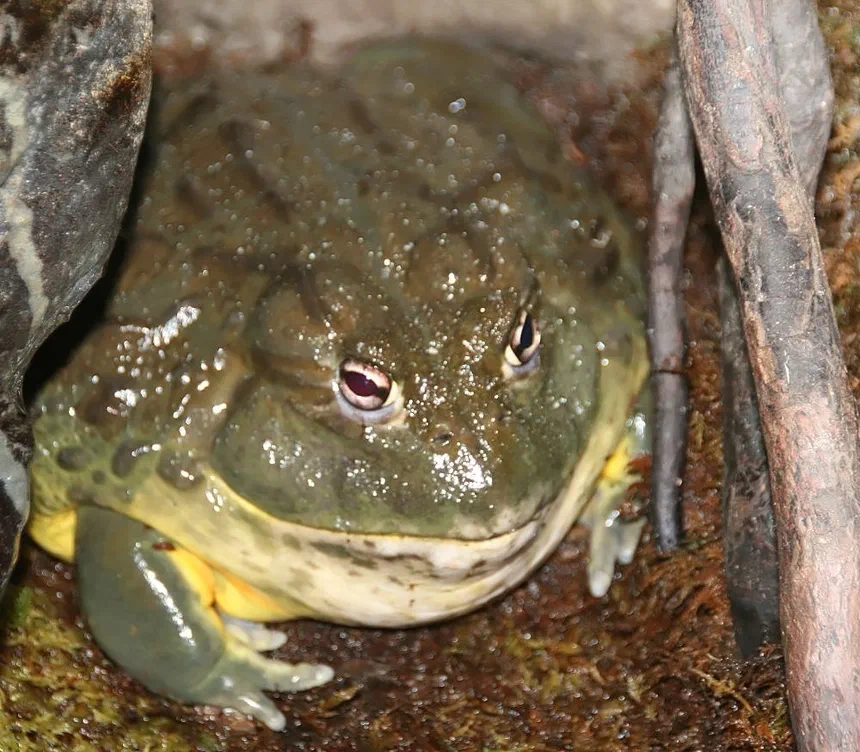
Image: David J. Stang — CC BY-SA 4.0 · source
What Is a African Bullfrog?
The African bullfrog (Pyxicephalus adspersus) is one of the largest frog species on the African continent and among the biggest frogs in the world. Also called the pixie frog, it is a stout, burrowing amphibian famous for its enormous appetite, aggressive temperament, and the striking size difference between hefty males and much smaller females.
Appearance and Identification
This is a heavily built, broad-bodied frog with a wide head and a large mouth that stretches nearly the width of its face. The skin is olive to grayish-green above, often marked with lengthwise ridges and folds, while the throat and belly are paler, sometimes cream or yellowish. Adult males are considerably larger than females, reaching body lengths of roughly 9 inches (23 centimeters) and weights that can approach or exceed 2 pounds (about 1 kilogram); females are typically less than half that size. A distinctive feature is the set of tooth-like bony projections, called odontoid structures, on the lower jaw, which the frog uses to grip struggling prey.
Habitat and Range
African bullfrogs are found across much of sub-Saharan Africa, with strongholds in southern and eastern portions of the continent, including countries such as South Africa, Namibia, Botswana, Zimbabwe, Mozambique, and parts of East Africa. They favor open savanna, grassland, and semi-arid landscapes where shallow seasonal pans, temporary pools, and flooded depressions form after rains. Because these habitats are dry for much of the year, the species is strongly tied to the timing of rainfall and spends long stretches buried underground.
Diet
This frog is an opportunistic carnivore with a famously indiscriminate appetite. It will ambush and swallow almost any animal it can overpower, including insects, spiders, other frogs (sometimes members of its own species), small reptiles, small mammals such as rodents, and even young birds. Prey is typically seized with a rapid lunge, gripped by the powerful jaws and odontoid projections, and worked into the mouth with the help of the forelimbs.
Behavior
For much of the year the African bullfrog is a solitary, secretive animal. During the dry season it burrows into the soil and encases itself in a tough, waterproof cocoon formed from layers of shed skin, entering a dormant state called estivation that can last many months until the rains return. When active, it is bold and pugnacious, readily inflating its body and lunging at threats. Males in particular are known for defending territories and can deliver a strong bite.
Life Cycle and Reproduction
Breeding is triggered by heavy seasonal rains that fill temporary pools. Large males gather and compete aggressively for prime positions in the shallows, wrestling and shoving rivals. After mating, females deposit thousands of eggs, which hatch into tadpoles within a few days. In a behavior unusual among frogs, males often guard the developing tadpoles, remaining nearby and even digging channels to keep the shrinking pools connected so the young are not stranded. Tadpoles develop quickly to metamorphose before their pool dries out, and the frogs may take a few years to reach full size.
Conservation Status
The African bullfrog is currently listed as Least Concern by the IUCN, reflecting its wide distribution and large overall population. Even so, local populations face pressures from wetland drainage, habitat loss, road mortality, pollution, and collection for the pet trade and, in some areas, for food. Protecting the seasonal wetlands on which breeding depends is important for keeping regional populations healthy.
Frequently Asked Questions
How big can an African bullfrog get? Large males can reach a body length of around 9 inches (23 centimeters) and weigh close to or over 2 pounds (roughly 1 kilogram), making them one of the heaviest frogs in Africa. Females are noticeably smaller.
Are African bullfrogs aggressive? Yes. They are known for a bold, pugnacious nature, will lunge and bite when threatened, and their bony jaw projections can deliver a surprisingly firm nip.
How do they survive the dry season? They burrow underground and form a protective cocoon of shed skin, entering a dormant state called estivation that can last for months until seasonal rains return.
References
The conservation status and key facts in this profile are supported by these sources:
- Animal Diversity Web — Pyxicephalus adspersus (accessed 2026-07-29)
- GBIF — Pyxicephalus adspersus (accessed 2026-07-29)
Found an error, source problem, or image concern? Report this page.